08.10-01.11.26
Hours Space Berlin
by Misha Salome Bekele
The feel of a thing can be connected to the quality of tone it creates around or within itself. A show, for example, can elicit a certain type of hubbub and buzz – such as the cheerful but nonetheless focused chatter at Hours Kunstverein in Berlin for the opening of Companions: Act I, foreshadowing Act II and Act III, which were to follow on the 12th of November.
I arrived early at the gallery. As it was cold outside, there was little patience in my body to endure the first tugs of fall, which persistently tried to creep underneath my coat. So I braced myself for the embarrassment of being the first to appear and rang the bell at Hours, so neatly tucked away by roaring Hermannplatz on a street named Lucy.
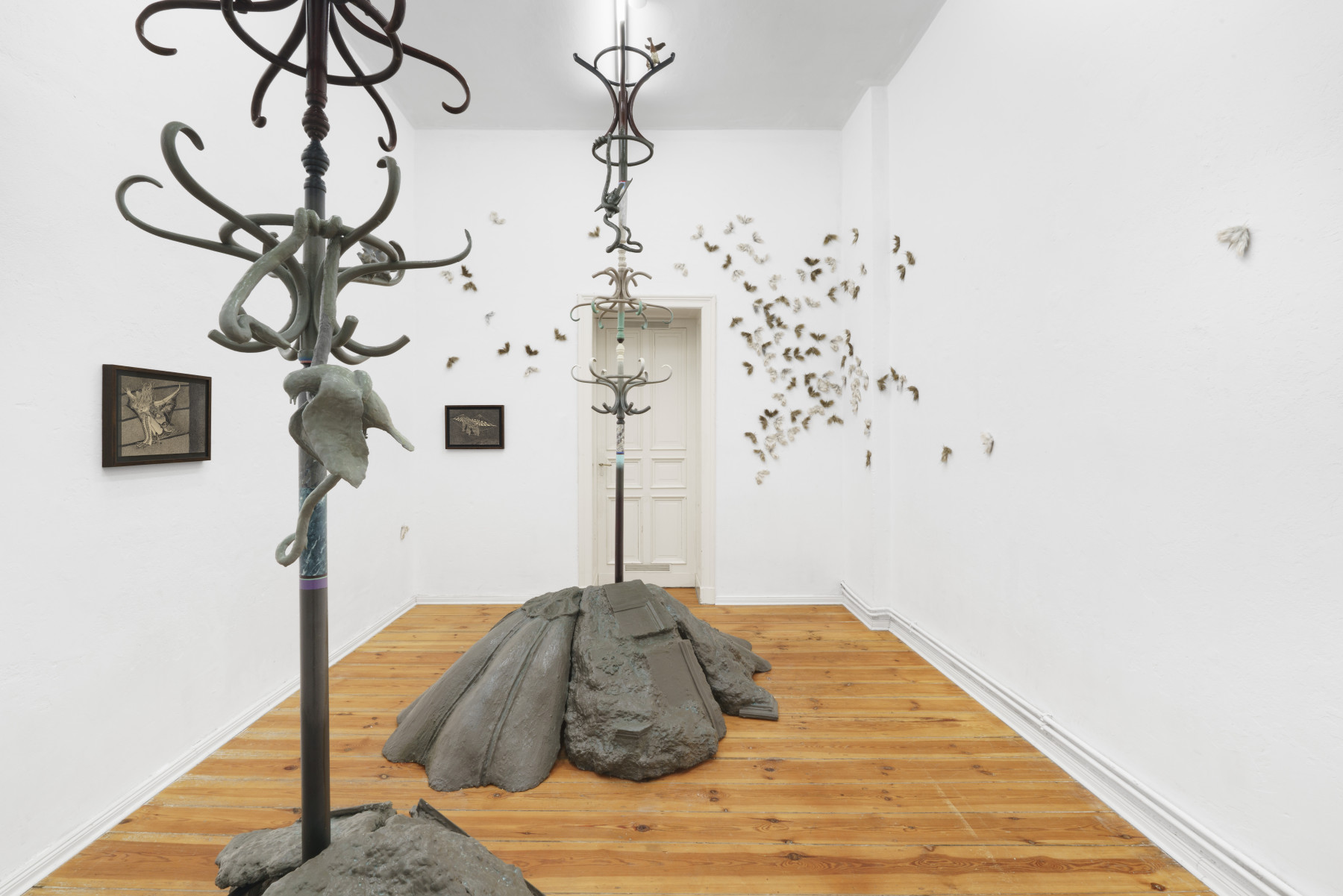
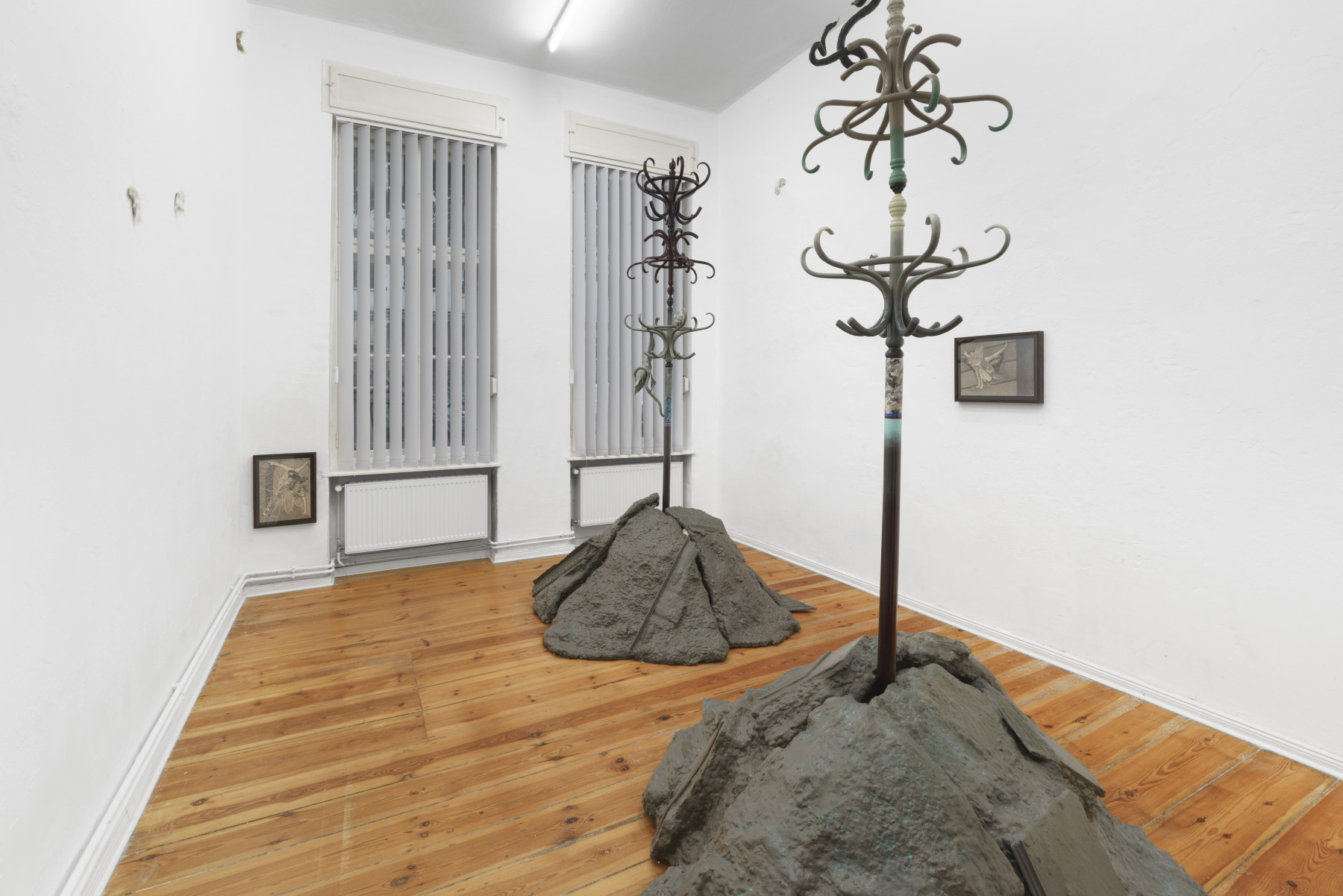
What I entered was a space populated by chimeric, fuzzy and dazzling creatures. In their midst stood two towering trees, upon which rested a small flock of birds, watching on as one of their own was strangled by a malicious serpent. The tree itself, re-imagined and assembled by means of its own decorative abstraction.
Two weeks later, I returned to Hours. This time to meet the artists and converse about their show. Within a few minutes I found the trio Min-Jia, Hou Ching and Brad Nath crammed shoulder to shoulder on a tiny green couch and myself on a low chair at their feet.
Min-Jia presented a clip on their phone of Japanese wrestlers clad in frilly, hyper-feminine costumes performing death-defying moves before bouncing off the hard canvas. All of that action delicately re-imagined in Min-Jia's highly detailed drawings Falling Machine and Flying Machine, where female wrestlers morph into animal form. Wrestling has long held me in its grip, offering a vicarious taste of the joys of digging into flesh. Now, however, I was faced with its transformative potential through carnal struggle.
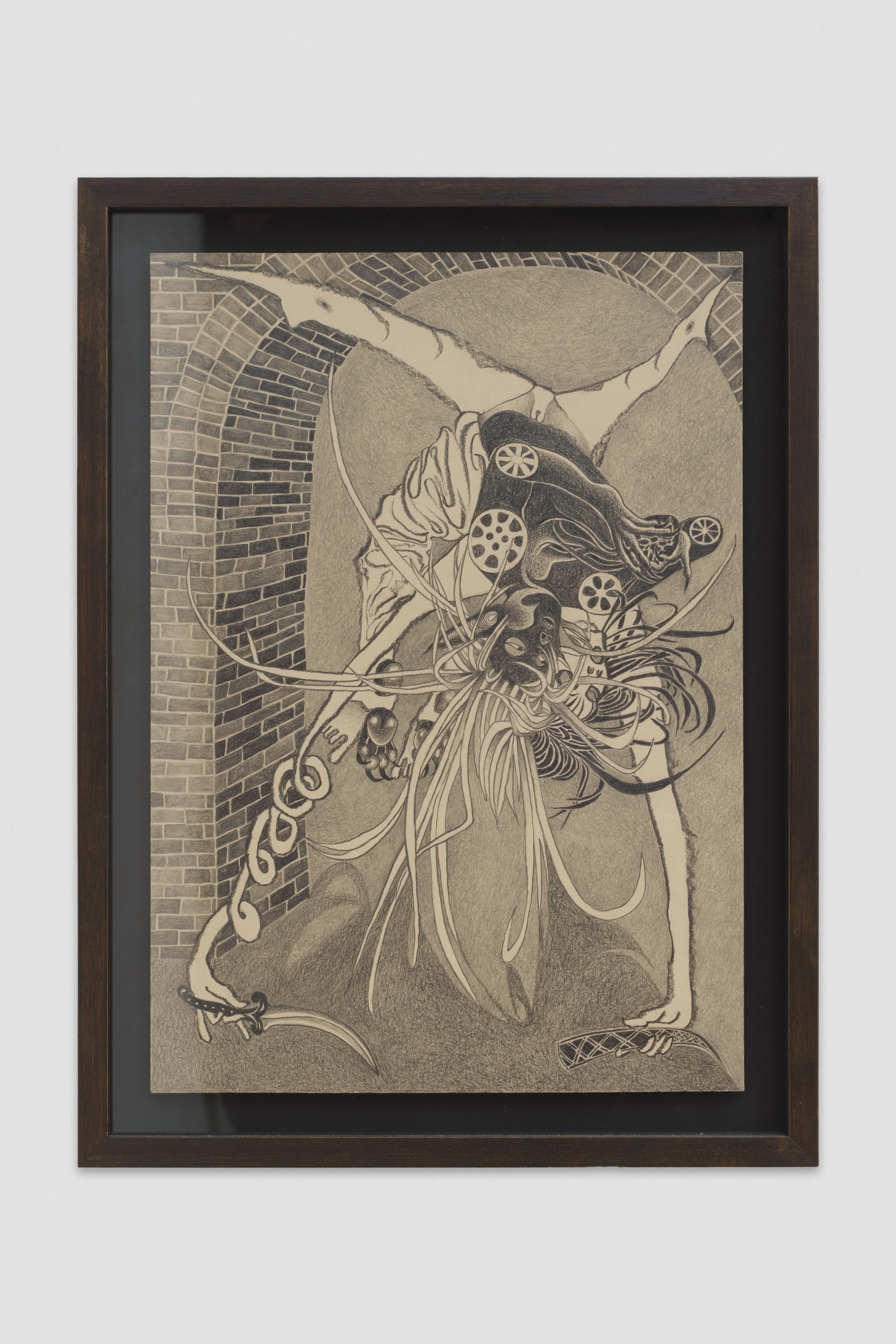
Min-Jia, Star, 2026, graphite on paper, 29.7 × 42 cm
Min-Jia’s drawings, however, speak of more than the spectacle of choreographed brutality. Morphing wrestlers made visible what could be brought to fruition in all of us: a marvelous shadow. Having practiced shadow puppetry for many years, Min-Jia was familiar with the tantalizing effects of external projection onto skin: projection of light, projection of expectation, projection of desire, projection of fear.
Swiftly, Min-Jia produced their phone to share a video where the wrestler Mizuki spun seemingly mid-air – a feat that was, as I was soon enlightened, an impossibility. “So what happens is that her opponent supports and spins her” Min-Jia explained. “They're supposed to be enemies but they actually work together in this performance of wrestling, which makes clear the labor that the body needs to sustain to maintain a certain type of identity.”
Talking to the artists made it apparent that each work served as a meditation on an estranged surface, standing in tension with its vibrant and shifting content. This was a show for those who considered themselves outsiders, outside of themselves and outside of society at large. What is it to inhabit an othered body? Having some personal experience on the matter made me connect to the artists' work in a way that moved me. Being made other is at its core not a theoretical but a spatial experience. And here I was in a space that offered familiar yet intriguing entry points.
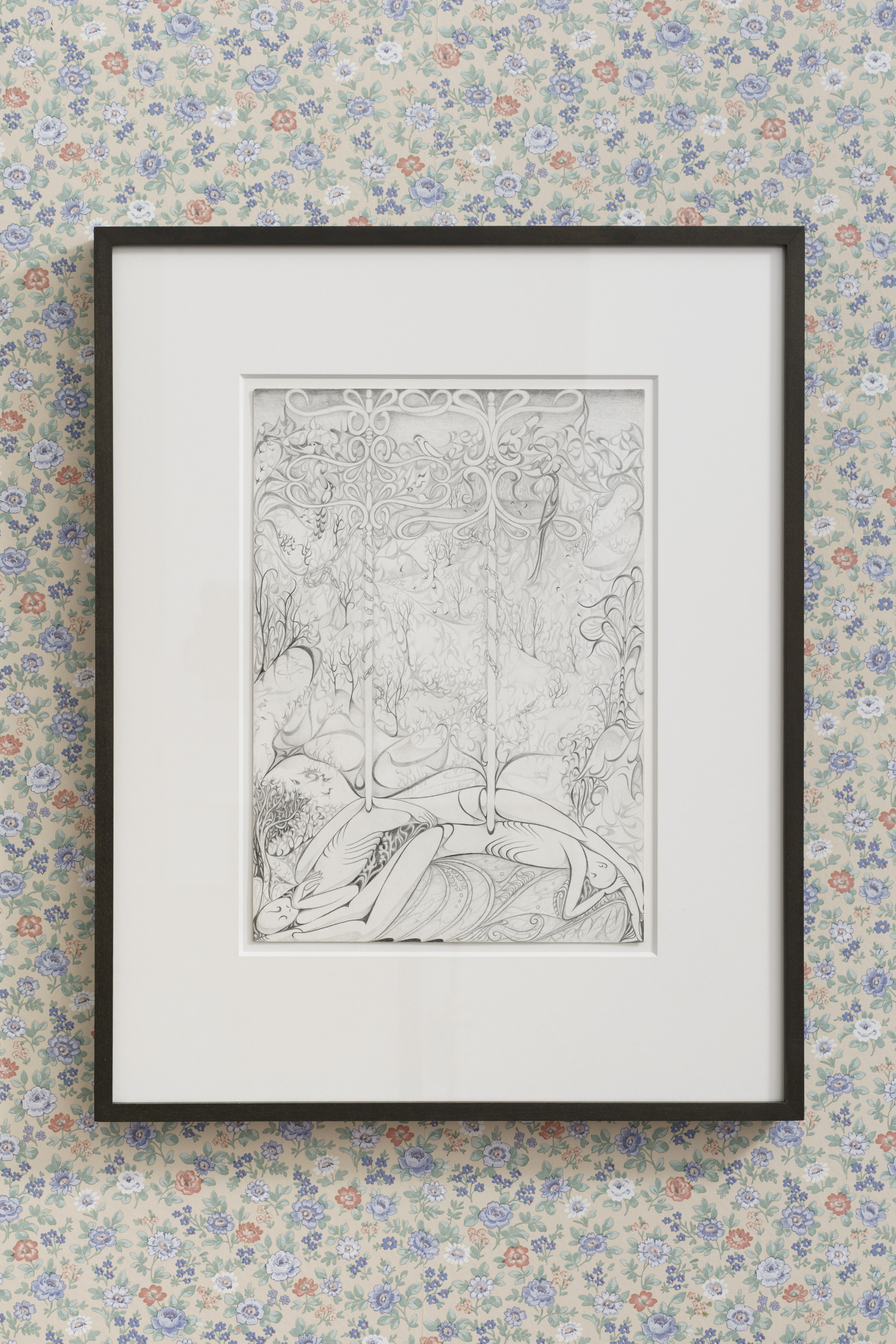
Hou Ching, Garden of Knowledge of Good and Evil, 2026, graphite on paper, 21 ×
Companions: Act I became a passage through the silken veil of bedazzlement – an experience that was skin-deep, making it hard to discern whether you are within or without. The day of the opening, when I played the unwitting first guest, I beheld Hou Ching's large trees in the center of the space. His Garden of Knowledge of Good and Evil became a materialization of ephemera. Here, the eternal was caught in shapes, and solid material was bent to create an intricate assembly of ornamentation.
Hou Ching elaborated on this. “Ornaments are often integral parts of the structure itself (…) but they serve little purpose other than mediating the space between the object and the viewer by drawing attention to the surface. By dazzling the viewer they create a distance that allows them to traverse into a different world.”
I could feel those effects take hold of me. The artists' work dissolved interior language within precisely this distance and extended an invitation to experience, just as promised, forbidden fruit of knowledge. This biblical tale of expulsion from paradise, although evoked in countless iterations, proved itself to still produce shapes that felt relevant.
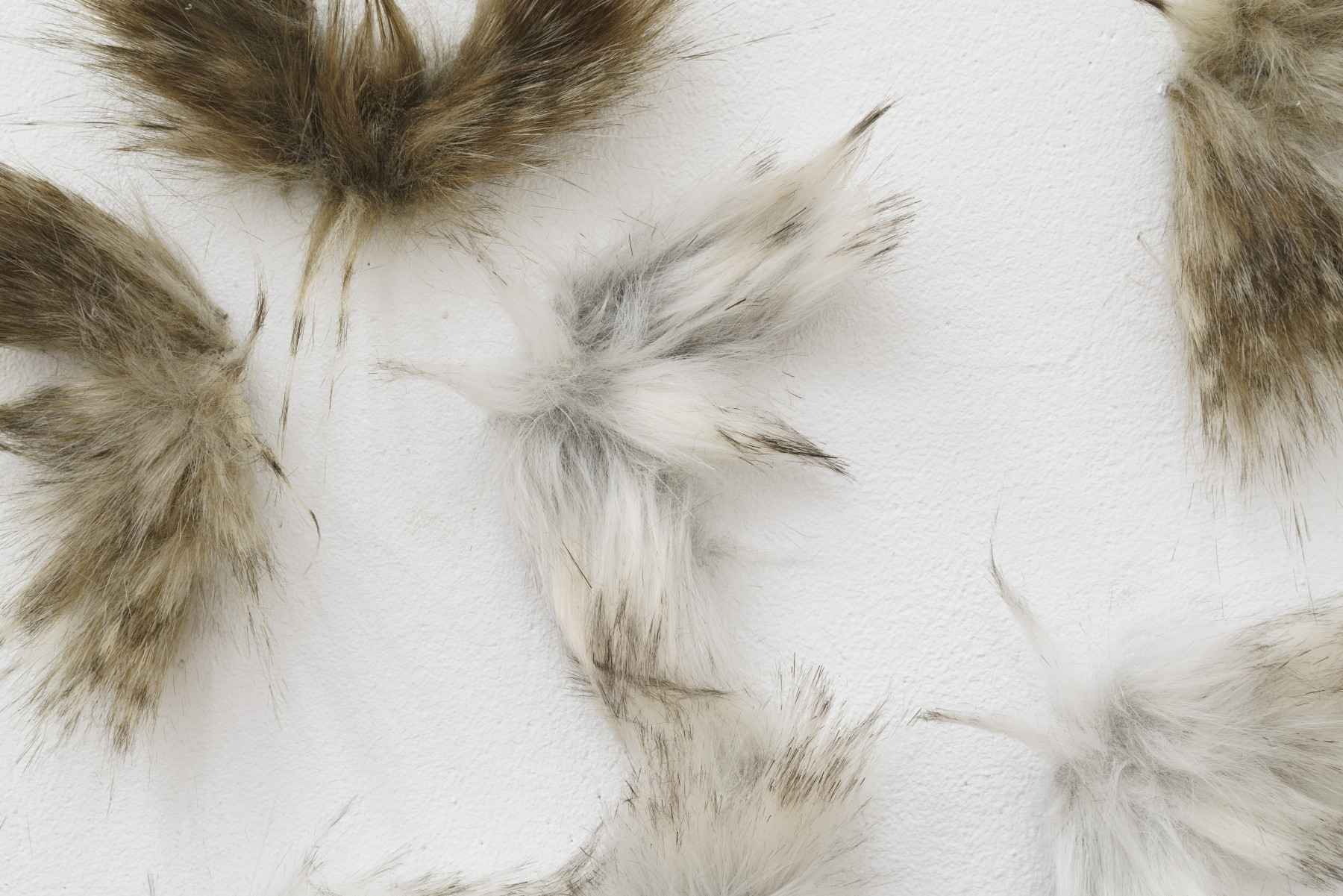
Brad Nath, Murmuration, 2026, faux fur, stainless steel, dimensions variable
The pamphlet crumpled in my hands spoke of transformation, and I wondered whether transformation was an adding-on or a stripping-off. Probably neither of the two, but a wicked third, as usual. The domestic silk moth, while still a caterpillar, fulfills its promise of transformation by producing valued fabric. The more common clothes moth fulfills its promise of building a home by eating through my favorite shirt.
Brad Nath's Murmuration, a series of 111 palm-sized moths made of faux fur, crept over the walls, seemingly longing for the thing that the cited angel number promised – a manifestation of new beginnings, turning thoughts into reality. Crammed on the couch with their two companions, Brad took a moment to deliberate over how to verbalize the trio's work and concluded that all of them were mainly interested in understanding the relation between the self and the other. Rather than trying to create truth they were interested in unsettling that relation by creating a hybrid space in which perhaps the self and the other are not as clearly distinguishable.
The trio, having recently immigrated to Berlin, found companionship amongst each other as they discussed the experience of otherhood throughout what turned into a year-long artistic process where many of the works presented in the show were generated. It might feel trite to say, but common experience creates common language and I recognised mine in theirs. To be an Other is to be both threat and victim; it is to be cherished and exploited; it is to be vile and sacred. To be an Other is to contain multitudes.
The animal is not a category but a relation, and the works offered a glimpse back into companionship itself – beyond fixed categories of human and animal. What constitutes the human extends far beyond mere species, given how some are treated more animalistic than others. Hou Ching picked up this train of thought: “And that is the whole negotiation of being excluded, of being displaced, of being…” “Tossed out of the garden of Eden,” I concluded.
And so I stepped back out onto the street again, faced with a city that so often insisted on the crude and harsh. With me lingered the fuzzy, dazzling and chimeric works and their notion that hard surfaces open into deep cracks, leading to an abyss where, at the very bottom, something soft and gorgeous awaits.
Misha Salomé Bekele is a Berlin- and Stockholm-based writer and artist.
Companions: Act I
Min-Jia
Brad Nath
Hou Ching
Hours Space Berlin
Curated by Yanne Horas